

In my years working with pressure relief systems, I’ve found that high temperature and corrosion are rarely independent variables; they are a destructive partnership that accelerates material fatigue and compromises system safety. When an engineer approaches me with a standard request for a "corrosion-resistant disk," my first question is always about the specific thermal profile of the process. A material that is inert at 20℃ can become highly reactive at 250℃, and ignoring this synergy is one of the most common precursors to premature fatigue or, worse, a delayed burst event.
The core conclusion for selecting rupture disks in extreme service is that material chemistry must be validated against the specific operating temperature to ensure burst accuracy and prevent premature failure. For most aggressive chemical processes, transitioning from 316 Stainless Steel to nickel-based alloys like Inconel or Hastelloy is a technical necessity, not an over-specification, as these materials maintain structural integrity where standard steels soften. My recommendation is to prioritize a "Reverse Acting" design for cyclic or high-pressure applications to isolate the disk from fatigue, while utilizing PTFE linings only when the operating temperature remains strictly below 260℃ (500℉).
Navigating these selections requires moving beyond simple compatibility charts and looking at how the physics of the disk changes under load. Below, I’ve outlined the decision logic we use to evaluate these complex environments, focusing on the trade-offs between material longevity and safety compliance.
The primary risk in high-temperature service is "creep" and the natural reduction in the material's tensile strength. As the temperature rises, the pressure required to burst the disk typically decreases. If your selection doesn't account for the specific temperature at the disk's installation point, you risk a "nuisance burst" where the disk fails well below the intended system pressure.
When you add corrosive media to the mix, the failure risks are compounded. Corrosion thins the membrane, which is already under thermal stress. This interaction creates a moving target for safety margins. In my experience, the most dangerous scenario is "stress corrosion cracking," where the combination of the disk’s internal tension and a corrosive agent causes a sudden, brittle failure. We aren't just selecting a material; we are managing the degradation rate to ensure the disk stays within its ASME-mandated burst tolerance throughout its service life.
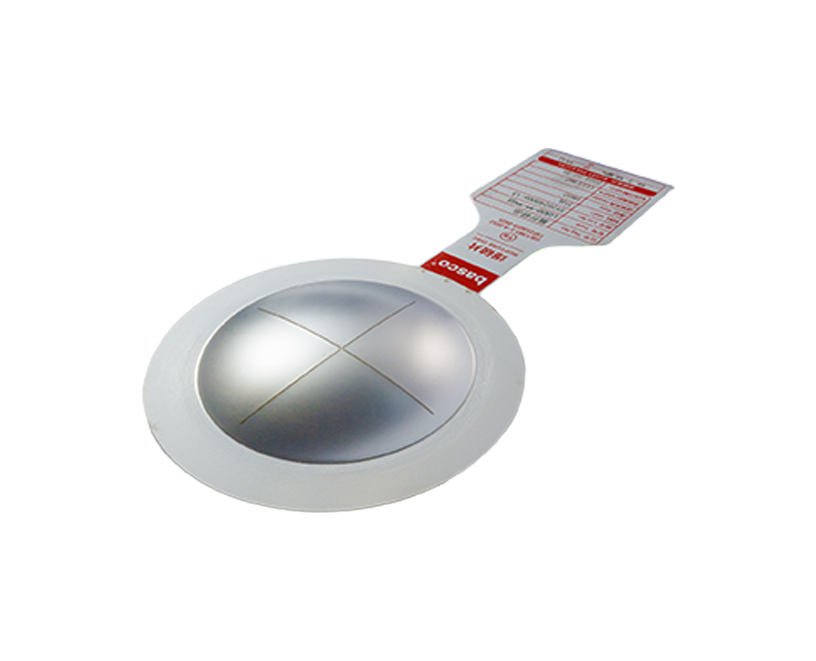
BASCO rupture disk
The temperature at the disk surface, not just the process bulk temperature, dictates the burst pressure. I often see engineers provide the "design temperature" of the vessel, which might be significantly higher than what the disk actually sees at the end of a stagnant piping leg. Using a disk calibrated for the wrong temperature is the fastest way to compromise accuracy.
We categorize media by their ability to cause pitting, general thinning, or embrittlement. For instance, wet chlorine requires entirely different metallurgy than high-temperature steam. We must also account for the phase of the media; vapor-phase corrosion can sometimes be more aggressive at the liquid-gas interface right where the disk sits.
If your process cycles from ambient to high heat frequently, the disk undergoes constant expansion and contraction. This leads to metal fatigue. In these cases, I almost always steer clients toward reverse-acting disks, which are generally more robust against vacuum and cycling than forward-acting designs.
While 316 Stainless Steel is the "workhorse" of the industry, it is often inadequate for high-temperature mineral acids or chlorides. When we hit those limits, we move to nickel-based alloys. Inconel 600 is excellent for high-temperature oxidation resistance, while Monel is my go-to for hydrofluoric acid applications.
Hastelloy C276 is perhaps the most versatile material for aggressive chemical processing due to its resistance to a wide array of ferric and cupric chlorides. For the most extreme cases where even Hastelloy fails, we look at Tantalum. It is expensive, but in a highly corrosive reactor, the cost of a Tantalum-lined disk is a fraction of the cost of a single hour of unplanned downtime.
PTFE linings offer incredible chemical resistance at a lower price point than exotic alloys. However, they have a "thermal ceiling." Once you move past 260℃ (500℉), PTFE begins to soften and can lead to seal integrity issues. I treat coatings as a secondary line of defense—they are great for atmospheric protection but should not be the primary strategy for aggressive process-side chemicals if the coating integrity cannot be guaranteed during the burst sequence.
|
Material |
Max Temp Guidance |
Best For... |
Common Trade-off |
|
316 Stainless Steel |
482℃ (900℉) |
General utility, mild organics |
Prone to chloride stress cracking |
|
Inconel 600 |
593℃ (1100℉) |
High-temp oxidation |
Limited resistance to sulfur |
|
Hastelloy C276 |
482℃ (900℉) |
Strong acids, mixed chemicals |
Higher initial cost |
|
PTFE Lined |
260℃ (500℉) |
Highly aggressive acids |
Temperature limited; vacuum risk |
One of the most frequent errors I encounter is "over-specification" without lifecycle analysis. An engineer might specify a solid Tantalum disk when a lined disk or a different alloy would suffice, needlessly inflating the budget. Conversely, "ignoring temperature effects" is the most common technical error. If you buy a disk rated for 100PSI at 20℃, but install it in a 200℃ line, that disk might burst at 85 PSI.
Another oversight is neglecting back pressure. In high-temperature gas systems, the pressure on the downstream side of the disk can fluctuate. If the disk isn't designed to handle this, the resulting "back-pressure bias" can shift the burst point or cause the disk to fail prematurely. We always look at the ASME compliance logic to ensure the safety margins are wide enough to account for these environmental variables.

From 《Surface Production Operations》(2016)
There is no "one-size-fits-all" answer for replacement frequency, but "wait until it bursts" is not a strategy. In highly corrosive service, I recommend a baseline inspection after 6 months. We look for signs of pitting or discoloration. If the disk looks pristine, the interval can be extended. However, if there is visible degradation, the replacement cycle should be set at half the expected failure time to ensure you are always operating within the safety margin.
In my experience, the cost of a rupture disk is negligible compared to the cost of a vessel failure or an environmental release. Selecting the right metallurgy and design today is an investment in your plant's operational continuity. If you are currently struggling with frequent nuisance bursts or are designing a new high-temp process, I can help you evaluate your specific pressure-temperature-media matrix to find the most stable solution.

Where Are Rupture Disks Used in Chemical and Petrochemical Plants?
2026-09-21Burst Pressure Tolerance Explained: How Accurate Are Rupture Disks?
2026-09-16Full-Process Quality Control for Rupture Discs
2026-09-01Rupture Disk Selection Guide: How to Choose the Right Type, Pressure, Material, and Size
2026-08-25Copyright © Jiangsu Bafang Safety Device Co., LTD. All Rights Reserved