

As a BASCO engineer, I have worked with many industrial customers who face the same challenge: protecting storage tanks, pipelines, and process equipment from dangerous flame propagation while maintaining reliable operation. In industries handling flammable gases and vapors, a flame arrester is not just a safety accessory. It is a critical protection device designed to stop combustion from traveling into protected equipment.
From my experience, the right flame arrester selection depends on understanding the actual operating conditions, including gas composition, pressure, temperature, installation location, and maintenance requirements. BASCO recommends selecting flame arresters based on engineering conditions rather than simply choosing a standard model. End-of-line flame arresters are suitable for tank vents and atmospheric protection, while in-line flame arresters are designed for pipeline applications where flame transmission risks exist. The best solution balances safety performance, pressure loss, maintenance needs, and long-term reliability.
In this article, I will explain how flame arresters work, how BASCO designs and classifies them, what components affect performance, and how engineers should evaluate different types before making a purchasing decision.

Structure diagram of BASCO flame arrester.
A flame arrester is a passive safety device installed in industrial systems to prevent flame transmission. Its main purpose is to allow gases or vapors to flow during normal operation while stopping an uncontrolled flame from passing through the equipment.
In real projects, I often see customers focus mainly on pressure ratings or connection sizes. However, the most important question is whether the flame arrester matches the actual combustion risk. A device that is suitable for one application may not provide enough protection in another system.
The working principle is based on controlling heat transfer. When a flame enters the flame arrester element, the internal metal structure absorbs and removes heat from the flame front. Once the temperature drops below the ignition point of the gas mixture, the flame cannot continue traveling.
BASCO flame arrester working principle.
The most important part inside a flame arrester is the flame arresting element. BASCO designs the element to create a controlled passage area where gas can flow, but flame energy is reduced through heat absorption.
The element usually contains multiple narrow passages. These passages reduce flame speed and increase contact between the flame and the metal surface. The heat is transferred away from the combustion zone until the flame is extinguished.
Engineering Insight: The flame element must achieve the right balance. If the passages are too small, pressure loss increases. If they are too large, flame quenching performance may be reduced. Professional design requires balancing safety and system efficiency.
A common mistake I see in industrial projects is selecting a flame arrester only by pipe size. The internal design directly affects pressure loss. Excessive pressure drop can impact tank breathing, process stability, and equipment performance.
For this reason, BASCO engineers consider flow rate, operating pressure, and gas properties before recommending a suitable configuration.
| Selection Factor | Why It Matters | Engineering Consideration |
|---|---|---|
| Gas composition | Different gases have different flame characteristics | Select suitable flame group and protection level |
| Flow rate | Affects pressure loss | Ensure stable equipment operation |
| Installation location | Determines flame risk direction | Choose end-of-line or in-line design |
| Maintenance condition | Impacts long-term reliability | Select inspection-friendly structures |
Understanding the internal structure helps engineers make better decisions. Although designs vary depending on application, most industrial flame arresters contain several important components.

Main components of BASCO flame arrester.
The flame arresting element is responsible for stopping flame movement. Its material selection, passage design, and manufacturing accuracy directly influence safety performance.
The housing protects the internal element and provides mechanical strength. In industrial environments, the housing must handle pressure, vibration, corrosion risks, and outdoor conditions.
Connection type affects installation reliability. BASCO designs different connection options to meet different piping systems and equipment requirements.
A flame arrester is a safety device, but it also requires regular inspection. A practical design should allow engineers to check the element condition and remove contamination when necessary.
In industrial applications, flame arresters are mainly classified based on their installation position and protection purpose. At BASCO, we usually help customers decide between end-of-line flame arresters and in-line flame arresters according to the actual risk location.
Choosing the wrong type can create unnecessary pressure loss or insufficient protection. The installation environment should always guide the selection process.

BASCO flame arrester classification.
An end-of-line flame arrester is normally installed at the open end of a vent line or equipment outlet. Its main purpose is to prevent an external flame source from entering the equipment.
I commonly recommend this type for storage tanks, process vessels, and vent systems where the main concern is atmospheric ignition. These applications require protection while allowing normal vapor release.
An in-line flame arrester is installed inside a pipeline system. It protects against flame traveling through connected pipes and process equipment.
In my experience, pipeline applications require more detailed evaluation because flame behavior can change with pipe length, gas velocity, pressure, and operating conditions.
| Flame Arrester Type | Typical Installation | Main Protection Purpose |
|---|---|---|
| End-of-line flame arrester | Tank vents, vessel outlets, breathing systems | Prevent external flame from entering equipment |
| In-line flame arrester | Pipelines and process connections | Stop flame propagation through piping systems |
Storage tanks containing flammable liquids often need protection from external ignition sources. During normal operation, tanks must release vapor safely. However, if an external flame reaches the vent opening, combustion can travel into the tank.
A BASCO end-of-line flame arrester creates a protective barrier at the vent point. The device allows gas flow but prevents flame transmission into the protected equipment.
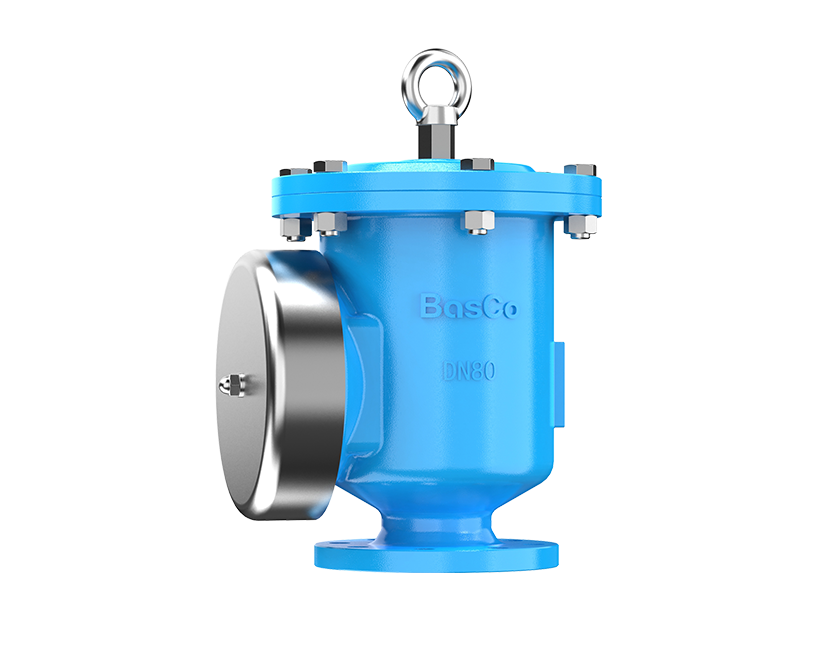
BASCO End-of-line Pressure Vacuum Relief Valve with Integrated Flame Arrester.
For tank protection applications, integrating a pressure vacuum relief valve with a flame arrester can provide both pressure control and flame protection in one solution.
This integrated design helps reduce installation complexity and saves space. It also allows engineers to manage tank pressure and combustion risks together.
Laboratory testing and engineering verification are important because flame behavior is affected by many variables. At BASCO, we focus on demonstrating the difference between protected and unprotected systems.
The following comparison tests show how flame arresters prevent flame transmission under controlled conditions.
Comparison testing with and without an end-of-line flame arrester.
Comparison testing with and without an in-line flame arrester.
The key lesson from these tests is that flame arresters are passive protection devices, but their effectiveness depends completely on correct selection and installation.
Not every gas handling system requires the same protection method. Engineers should evaluate flame risk during the early design stage instead of adding protection after problems appear.
From customer projects I have supported, the following situations usually require careful flame arrester evaluation:
One common mistake is selecting a flame arrester only by connection size. A 4-inch flame arrester is not automatically suitable for every 4-inch pipeline.
Another mistake is ignoring maintenance conditions. A flame arrester installed in a dusty or corrosive environment may require easier inspection and cleaning access.
BASCO Engineering Recommendation: Always evaluate flame characteristics, operating conditions, installation location, and maintenance requirements together. A flame arrester is part of a complete safety system, not an isolated component.
When customers consult BASCO, we usually review several technical points before recommending a solution. This approach helps avoid over-design or under-protection.
| Evaluation Point | Questions Engineers Should Ask |
|---|---|
| Application | Is the protection required at a vent opening or inside a pipeline? |
| Medium | What type of gas or vapor is being handled? |
| Operating conditions | What are the pressure, temperature, and flow requirements? |
| Maintenance | How often will inspection and cleaning be required? |
| System reliability | Will pressure loss affect process operation? |
At BASCO, we understand that industrial safety equipment must perform reliably for years after installation. Our engineering approach focuses not only on flame stopping performance but also on practical operation.
We work with customers to understand their process conditions, installation environment, and long-term maintenance expectations. This helps us provide solutions that fit the actual project rather than simply supplying a standard product.
A reliable flame arrester should provide protection without creating unnecessary operational problems. This is the balance we focus on when designing and recommending BASCO flame arrester products.
Every industrial system has different flame risks and operating conditions. If you are designing a tank vent system, pipeline protection solution, or process safety upgrade, BASCO engineers can help evaluate the right flame arrester configuration.
Contact BASCO for professional flame arrester selection support and engineering consultation.
Contact BASCO EngineersIn my experience, the best flame arrester solution is not always the largest or most expensive option. It is the one that matches the real operating conditions and provides reliable protection without affecting system performance.
Engineers and purchasing teams should consider flame characteristics, installation position, pressure loss, maintenance needs, and future operation requirements before making a decision.
At BASCO, we continue to focus on practical engineering solutions that help customers improve industrial safety and equipment reliability. If you are evaluating a flame arrester application, our team is ready to support your project with professional recommendations.

Copyright © Jiangsu Bafang Safety Device Co., LTD. All Rights Reserved