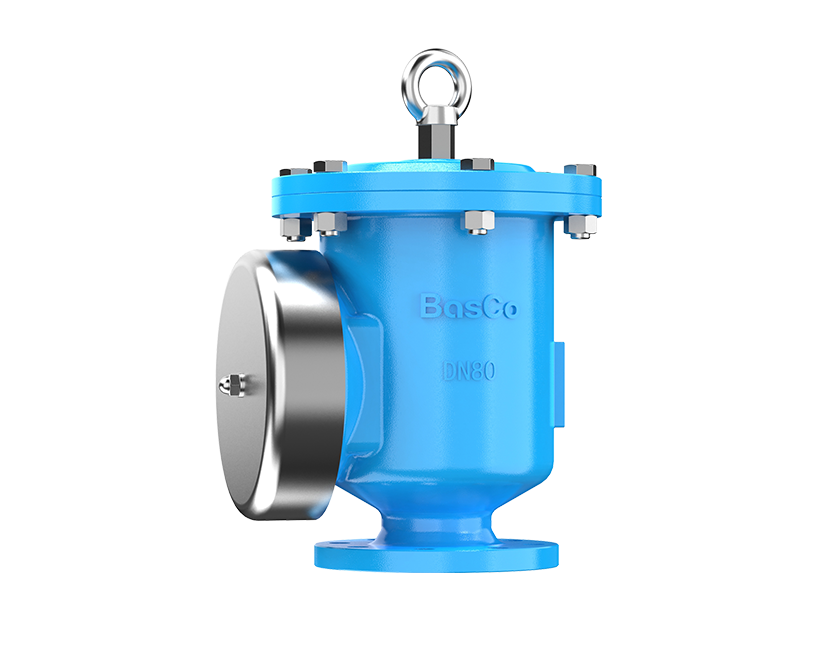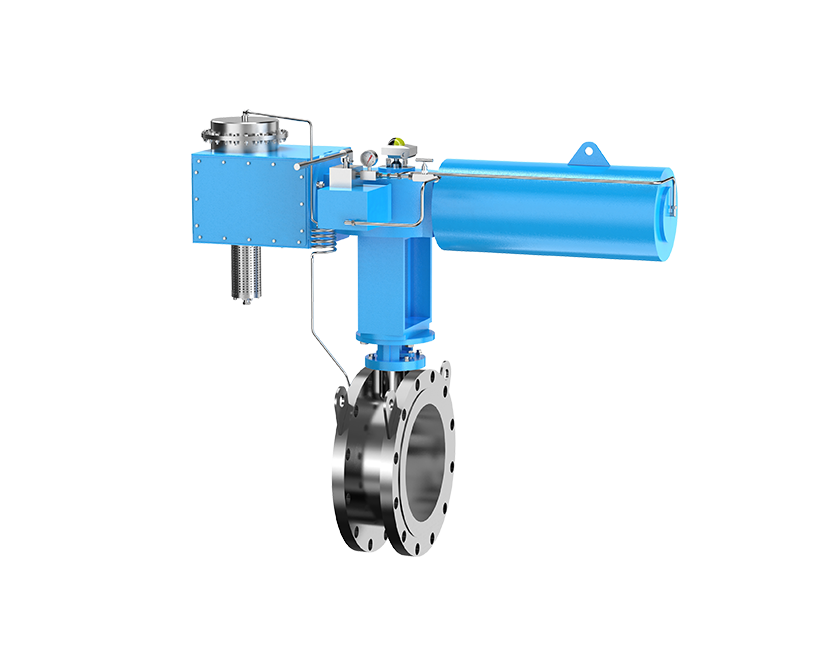


An in-line stable detonation flame arrester is a safety device installed inside a pipe run to stop flame transmission when the hazard isn't just a low-speed flame (deflagration), but a detonation that has stabilized in the pipe—meaning the flame front is coupled with a shock wave and propagates at (or near) the speed of sound in the reactive mixture. In practical terms, it's built and tested to survive and quench a much more violent event than a typical in-line deflagration arrester.
The “in-line” part matters for engineering: you are not protecting an open vent to atmosphere; you're protecting equipment and pipe segments on the far side of the device from flame acceleration that can occur in confined piping. The arrester is usually flanged (or otherwise mechanically robust), with an internal flame element sized to quench flame while also withstanding detonation pressure loads.
In practical engineering terms, an in-line stable detonation flame arrester is not a standalone safeguard, but a critical component within a broader tank protection system, working alongside venting devices, pressure relief valves, and explosion prevention measures to control ignition and overpressure risks.
In procurement and project specs, “stable detonation” shouldn't be treated as a vague performance claim. In standards language, it is a specific flame transmission classification with defined test methods and marking requirements under ISO/IEC 80079-49:2024, which establishes classification, construction expectations, marking, and verification tests for flame arresters.
A deflagration arrester is built to stop a flame front moving subsonically, typically with far lower pressure rise than a detonation. A stable detonation arrester must handle a fundamentally different phenomenon: a shock-compressed reaction zone with extremely fast pressure rise. That difference changes three procurement-critical things:
If you buy the wrong class, you don't just “reduce safety margin”—you may be specifying a device that is not validated for the event your pipe can realistically develop.

A real-world piping hazard is rarely static. Many incidents start as deflagration and then accelerate, and the system geometry decides whether the event stays “burning fast” or becomes “exploding fast”. Process engineers and project buyers should think in terms of confinement + run-up distance + turbulence + mixture sensitivity.
A deflagration flame front propagates below the local speed of sound in the unburned mixture. It can still be destructive—especially if confined—but the pressure rise is generally lower and slower than a detonation. A stable detonation propagates with a shock wave; this is where pressure loads and instantaneous forces become the selection driver, not just “flame blocking”.
In piping, the hazard escalates because the pipe can act like an engine: bends, valves, reducers, flame arresters placed too far away, or even rough pipe internals can generate turbulence and accelerate the flame. Once the event transitions, the arrester needs detonation-rated performance and the mechanical integrity to survive the load.
Stable detonation is more dangerous in procurement terms because it collapses your response time to nearly zero and replaces “thermal quenching” as the main challenge with “thermal quenching under shock loading”. The arrester must stop flame transmission while surviving the shock wave and peak pressure that arrives essentially at the same time.
This is why many manufacturers and standards discussions emphasize classification and test validation. A detonation device is not simply a deflagration device with a thicker body; the internal element design, retention method, housing strength, and acceptable installation conditions change materially.

An engineering-accurate way to describe operation is: an in-line stable detonation arrester is designed to disrupt the detonation structure and quench the flame kernel so the flame cannot pass through to the protected side.
In a stable detonation, the shock wave compresses and heats the unburned mixture, which strongly supports rapid reaction. The arrester's job is twofold.
First, it must attenuate and de-couple the shock/flame system. The detonation wave structure depends on a coupled shock and reaction zone; forcing the flow through a designed matrix changes wave propagation and reduces the ability of the wave to sustain itself.
Second, it must quench the flame by rapidly removing heat from the flame front. That is classic flame arresting, but under a much harsher boundary condition because the event arrives with high pressure and high turbulence. This is why stable detonation-rated devices are tested and marked according to the classification and performance requirements defined in ISO/IEC 80079-49:2024 for flame arresters used in explosive atmospheres.
Most industrial flame elements are engineered metal structures (for example, wound crimped ribbon, sintered metal, or layered matrices) that create many small channels. The practical selection logic is: the element must keep the effective passage dimensions below the mixture's quenching distance and support rapid heat transfer, while also maintaining integrity under detonation pressure loads.
For procurement, don't treat the “element type” as marketing. Ask what gas groups the element is tested for, what the certified limits are, and what the maintenance approach is (cleanable vs replaceable, spare element lead time, differential pressure monitoring options). The current international standard ISO/IEC 80079-49:2024 defines the performance requirements, test methods, marking, and limits for use of flame arresters intended to prevent flame transmission in gas and vapor-air mixtures.

You need stable detonation protection when your system can plausibly develop a detonation in the pipe segment you're trying to protect. That decision should be made from piping reality: length, confinement, ignition locations, and mixture sensitivity.
Longer pipe runs provide distance for flame acceleration. Even if an ignition begins as a deflagration, a sufficiently long run with turbulence promoters (elbows, tees, valves, strainers, roughness, instrumentation intrusions) can allow the flame to accelerate and transition.
From a selection standpoint, the key is not “the pipe is long” but “there is enough run-up distance between a credible ignition source and the device or protected equipment”. If ignition can occur far upstream—maintenance activities, static discharge, hot surfaces, compressor discharge, or backflow—then the arrester must be rated for the worst credible mode at the device location.
Detonation risk spikes in confined systems. Closed pipework traps pressure, increases turbulence, and can create conditions where an initial burn becomes an accelerating flame. Many detonation flame arresters are explicitly described for use in open and closed pipework on the unprotected side in manufacturer instructions, reflecting that confinement is a primary risk driver.
Emerson
If your process involves sealed headers, vapor balancing lines, or recovery manifolds—especially those that can contain flammable mixtures during normal or abnormal operation—stable detonation capability deserves serious consideration.
In industrial projects, the stable detonation trigger conditions commonly look like this in practice:
You have a flammable mixture in a pipe that can exist for more than a transient moment, and there is at least one credible ignition mechanism. The mixture may be more sensitive (hydrogen-rich streams are a typical example), the piping includes turbulence features, and the protected equipment has low tolerance to overpressure or flame ingress. Under these combined conditions, specifying only deflagration protection often becomes a paper safety measure rather than a true engineered barrier.

This is the section procurement teams should bookmark because it translates safety intent into purchase specs that actually survive commissioning and operations.
Material selection is not just corrosion resistance; it's also about maintaining element integrity and tolerances over time. Stainless steels are common for bodies and elements; higher alloy materials may be needed for sour service, chlorides, or aggressive organics. If your gas stream carries particulates, polymers, tars, or condensables, material choice and surface finish can directly affect fouling rate and cleaning survivability.
Procurement logic: specify materials based on process chemistry and maintenance method. If you expect frequent cleaning, ensure the element design supports disassembly without damaging the matrix, and that gaskets/fasteners are compatible with repeated torque cycles.
Sizing is where many projects silently fail. Buyers tend to match line size and move on, but stable detonation devices can be sensitive to installation conditions and flow regime. “Correct size” means the device is within its certified operating envelope for the actual flow, not just the nominal pipe diameter.
If your flow varies widely, consider whether the arrester sees low-flow condensation (fouling) at minimum rates and high differential pressure at maximum rates. Also consider whether the project includes future capacity expansion; flame arresters are often forgotten in revamp scope until they become a bottleneck.
Yes—detonation flame arresters cause pressure drop, because they force flow through an engineered matrix. The engineering question is not “does it cause pressure drop”, but “what pressure drop at what flow, and how will it change as the element loads up?”
Some manufacturer instructions explicitly tie inspection to excessive pressure drop at a known flow rate, which is a practical operational control method: you baseline ΔP after commissioning and track drift as a proxy for fouling.
Procurement logic: require a vendor pressure-drop curve (or certified ΔP data) across your operating range, and define an allowable dirty ΔP that triggers maintenance. This prevents the classic situation where a safety device becomes the reason the unit can't hit production rate.
Gas group compatibility is often the most “standards-looking” part of a datasheet, but it's one of the most important. The flame element must be tested/approved for the relevant gas group or mixture behavior; different gases have different quenching distances and explosion characteristics. ISO/IEC 80079-49:2024 establishes uniform principles for flame arrester classification, testing, and limits of use based on gas group, operating conditions, and installation constraints.
Procurement logic: don't specify “for hydrocarbons” or “for hydrogen” informally. Specify the gas group/mixture basis, operating pressure/temperature range, and any diluents (steam, nitrogen, CO₂) that could change behavior. Then require evidence of compliance within that envelope.

ISO/IEC 80079-49:2024 is the current international standard governing the performance requirements, test methods, marking, and limits for use of flame arresters in explosive atmospheres. It has formally replaced the withdrawn ISO 16852 standard and aligns flame arrester requirements with the IEC 60079 and IECEx framework. Legacy references to ISO 16852 may still appear in existing specifications, but new projects should reference ISO/IEC 80079-49:2024.
If the equipment is placed on the EU market for potentially explosive atmospheres, ATEX requirements can apply. The EU's ATEX framework (Directive 2014/34/EU) covers equipment and protective systems intended for use in potentially explosive atmospheres and sets essential requirements and conformity assessment expectations before products are placed on the market.
Procurement logic: “ATEX” is not a sticker. You should match the certification to the zone/category relevant to the installation and ensure documentation aligns with your site hazardous area classification and mechanical equipment requirements.
Depending on where your plant is built and operated, you may also encounter IECEx schemes in global projects. For example, certification and testing capability for flame arresters is discussed within IECEx-related certification activity in the market.
eurofins.com
The practical approach is: pick the governing jurisdictional requirement first (EU ATEX, IECEx in some global contexts, plus any national codes), then ensure your flame arrester performance standard, typically ISO/IEC 80079-49:2024, is aligned with the specific explosion hazard and jurisdictional requirements.

A frequent error is selecting a deflagration arrester because “detonation is unlikely”. In procurement reality, the correct question is whether the system has credible conditions for flame acceleration and transition. If the pipe run and congestion can produce detonation, you buy for that case—because the penalty for being wrong is catastrophic, while the penalty for being conservative is usually manageable pressure drop and cost.
Flame elements foul. If your stream carries aerosols, polymerizable vapors, rust scale, desiccant dust, or condensate, an arrester is a filter whether you like it or not. Vendors often include inspection guidance tied to pressure drop or periodic intervals, and some manuals explicitly call for inspection at least annually and earlier if excessive pressure drop is observed.
Procurement logic: include maintenance access (space for element removal), isolation valves if needed, spare element strategy, and differential pressure taps in the design basis. Buying the right device without the ability to maintain it is a predictable failure mode.
Projects sometimes discover late that the selected arrester creates unacceptable ΔP at peak flow, pushing compressors off their curve, reducing vapor recovery efficiency, or causing tank breathing issues. Pressure drop must be evaluated as part of system hydraulics, and the “dirty element” case must be considered, not just clean data.

In chemical plants, flame arresters appear in vent headers, reactor off-gas lines, solvent handling, and purge/relief networks where flammable mixtures can occur. The selection driver is often a combination of long pipe runs, multiple ignition sources, and complex tie-ins that create turbulence and run-up distance.
Hydrogen deserves explicit attention because it can behave very differently from heavier hydrocarbons, and selection must be aligned with the certified gas group/limits of use. In hydrogen blending, electrolyzer balance-of-plant, fuel handling, or purge headers, the consequence of flame propagation can be severe, and stable detonation-rated protection may be warranted depending on geometry and confinement.
VRU piping often has long runs, varying flow, and transient composition. There may be oxygen ingress scenarios, compressor discharge ignition possibilities, and multiple connected vessels. Here, a stable detonation in-line arrester is often evaluated as a protective barrier to prevent flame transmission into storage or process equipment—provided the pressure drop and maintenance plan are engineered into the package.

|
Decision Factor (What you're really buying for) |
In-Line Deflagration Arrester |
In-Line Stable Detonation Flame Arrester |
|
Credible event in your pipe |
Subsonic flame propagation |
Shock-coupled, near-sonic detonation propagation |
|
Typical piping context fit |
Short runs, low run-up potential, lower turbulence |
Longer runs, higher turbulence, confinement, credible DDT risk |
|
Mechanical load case |
Lower/medium pressure rise |
High instantaneous pressure and impulse loads |
|
Pressure drop impact |
Often lower |
Often higher; must be checked for clean and dirty element cases |
|
Where projects go wrong |
Assuming “detonation won't happen” |
Underestimating maintenance + ΔP monitoring needs |
|
Documentation you should demand |
Test classification + limits of use per ISO/IEC 80079-49:2024 |
Test classification + limits of use per ISO/IEC 80079-49:2024; clear detonation rating evidence |
If you're specifying an in-line stable detonation flame arrester, you're not buying a generic safety accessory—you're buying a validated barrier against a pipe-confined, shock-driven explosion mode. The selection should flow from your piping reality: credible ignition locations, run-up distance, confinement, turbulence features, gas group/mixture behavior, and whether your plant can maintain the arrester without turning it into a production bottleneck. Standards alignment matters because it is how performance claims become auditable engineering facts, and ISO/IEC 80079-49:2024 is the current baseline reference that should be reflected in flame arrester marking, documentation, and limits of use.
If you want, share these four inputs—pipe size + max/min flow, gas composition (including diluents), operating P/T, and a simple description of pipe length and fittings between ignition source and protected equipment—and BASCO will map them into a practical selection checklist you can hand to vendors for quotes (including what documentation to require and what failure modes to design out).
Sometimes, but you should treat them as different protective intents. End-of-line devices are often about protecting an open vent interface; in-line devices are about protecting downstream equipment within piping. If your hazard is flame travel through pipework, an in-line detonation-rated device may be appropriate, but it doesn't automatically satisfy requirements for an atmospheric vent termination (weather hooding, debris, external ignition exposure, drainage, and venting behavior). The correct answer comes from your P&ID intent: what exactly is being protected, from which ignition side, under what flow direction(s), and what is the credible explosion mode.
Start with line size, but don't end there. The “correct” size is the one that stays within the manufacturer's certified operating envelope while meeting process hydraulics. You want vendor curves for pressure drop vs flow, your normal/min/max flow cases, and you want to decide whatΔP you can tolerate when the element is partially fouled. If the system is bi-directional (common in vapor balance or certain recovery manifolds), ensure the arrester is rated and installed accordingly.
Yes. Any flame element matrix introduces a restriction, and detonation-rated matrices are not “free-flow”. The procurement step that prevents surprises is to require ΔP data across your flow range and to set an ooperational alarm maintenance trigger based on ΔP drift. Manufacturer guidance commonly links inspection to an excessive pressure drop at a known flow rate, which is a practical approach to maintaining both safety and throughput

How to Size a Pressure Vacuum Relief Valve According to API 2000
2026-08-18Flame Arrester Guide: Types, Applications, Selection, and Industrial Solutions
2026-08-04Common Causes of Dust Collector Explosions and How to Protect Against Them
2026-07-13BasCo conducts "CPR+AED Emergency Training to Strengthen Workplace Life Safety Defense"
2026-06-18Copyright © Jiangsu Bafang Safety Device Co., LTD. All Rights Reserved