

As someone who has spent years supporting industrial safety equipment in real plants—not just on paper—I've learned that flame arrester maintenance is one of the most misunderstood and underestimated responsibilities in hazardous process environments. Flame arresters sit quietly in piping systems, doing nothing for years, until the one moment when failure is catastrophic. That's why I always frame flame arrester inspection and cleaning as a risk management discipline, not a housekeeping task.
In this guide, I'll walk through how I approach flame arrester inspection, cleaning, and replacement decisions in real operating conditions. I'll explain what “visual inspection” actually means, how much blockage is too much, when cleaning becomes unsafe, and how improper maintenance can quietly destroy flame path integrity. My goal is to help engineers, maintenance teams, and safety managers make defensible, audit-ready decisions that protect both people and assets.
A flame arrester is designed to stop flame propagation by absorbing and dissipating heat through a precisely engineered flame path. That flame path—whether a crimped metal ribbon, perforated plate, or wire mesh—is not forgiving. Even small changes in geometry, surface condition, or cleanliness can compromise its performance.
In practice, flame arresters fail in two dangerous ways. The first is excessive blockage, which restricts flow and creates pressure drop, operational instability, or vacuum collapse. The second is flame path degradation, where corrosion, deformation, or aggressive cleaning enlarges the effective gap size and allows flame transmission. Both are common, and both are preventable.
Maintenance matters because flame arresters are passive devices. There's no alarm, no control loop, and no PLC warning you that something is wrong. If you don't inspect them correctly, you're relying on blind faith.

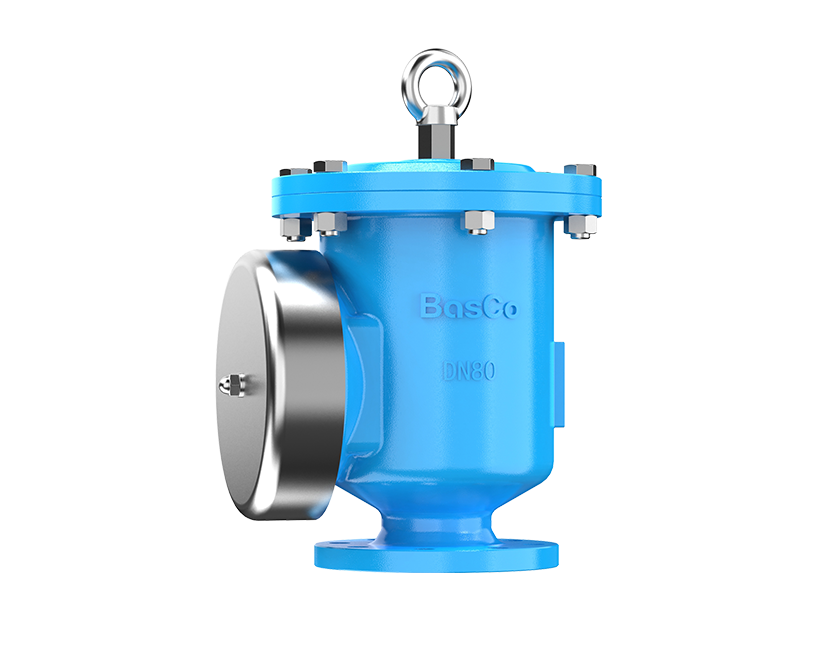
Structure diagram of BASCO flame Arrester
Inspection frequency is not universal, and any maintenance plan that treats all flame arresters the same is fundamentally flawed. I base inspection intervals on process contamination risk, operating duty, and historical fouling data.
In clean, dry vapor service—such as natural gas or light hydrocarbons—initial inspection may occur after the first three to six months of operation. If no fouling is observed, intervals can often be extended to annual inspections. However, once vapors contain polymers, resins, particulates, or condensables, inspection frequency must increase dramatically.
In dirty or reactive services, I've seen flame arresters plug to dangerous levels in less than 30 days. For these applications, monthly or even biweekly inspections may be justified until fouling behavior is fully understood.
|
Operating Condition |
Typical Inspection Frequency |
Rationale |
|
Clean dry gas |
6–12 months |
Low fouling potential |
|
Light condensables |
3–6 months |
Partial blockage risk |
|
Sticky vapors / polymers |
1–3 months |
Rapid flame path fouling |
|
Dust-laden air |
Monthly |
Mesh loading and pressure drop |
This table isn't theoretical—it reflects what actually keeps systems safe in the field.
One of the most dangerous phrases I hear in plants is, “We visually inspected it and it looked fine”. A true flame arrester visual inspection is structured, methodical, and intrusive.
Visual inspection means the arrester element is removed from the housing and examined under adequate lighting. You are not just checking for obvious debris. You are looking for subtle indicators of risk: uneven discoloration, bent ribbon edges, localized corrosion, or partial blockage deep within the element.
I always recommend inspecting from multiple angles and, when possible, backlighting the element. Light transmission gives immediate insight into blockage patterns that are invisible from the surface.
Key inspection criteria include:
If you can't clearly see through the flame path, you don't know its condition.
This is where engineering judgment must replace guesswork. While exact limits vary by manufacturer and certification standard, my rule of thumb is simple: any blockage that measurably increases pressure drop or disrupts uniform flow distribution is unacceptable.
From a safety perspective, blockage is dangerous for two reasons. First, it increases system pressure losses, which can affect venting capacity or process stability. Second—and more critically—it creates uneven flow paths. Flame arresters are tested under uniform conditions. Blockage concentrates flow through fewer channels, increasing local flame speeds and heat flux.
In practical terms, visible blockage approaching 25% of the flame path area should trigger corrective action. Anything beyond 40% is, in my experience, an immediate shutdown condition.
|
Blockage Level |
Risk Assessment |
Action |
|
<10% |
Acceptable |
Continue monitoring |
|
10–25% |
Elevated risk |
Schedule cleaning |
|
25–40% |
Dangerous |
Immediate maintenance |
|
>40% |
Critical |
Remove from service |
Ignoring blockage doesn't just reduce performance—it can invalidate certification assumptions entirely.
Cleaning methods must always respect the integrity of the flame path. I've seen more flame arresters ruined by aggressive cleaning than by actual process fouling.
Crimped metal ribbon elements typically tolerate solvent soaking and low-pressure flushing, but they are extremely vulnerable to mechanical damage. Wire mesh arresters, on the other hand, are especially sensitive to brushing or compressed air, which can stretch or distort the mesh.
Cleaning methods should be selected based on both arrester type and foulant chemistry. Non-metallic scrapers, approved solvents, and controlled ultrasonic cleaning are often safest when permitted by the manufacturer.
|
Flame Arrester Type |
Preferred Cleaning Method |
High-Risk Methods |
|
Crimped ribbon |
Solvent soak + low-pressure rinse |
Wire brushing |
|
Wire mesh |
Solvent soak only |
Compressed air |
|
Perforated plate |
Chemical cleaning |
Mechanical scraping |
If cleaning requires force, pressure, or abrasion, replacement is usually the safer option.

Picture of crimped ribbon element
One of the hardest calls for maintenance teams is knowing when to stop cleaning and start replacing. From my perspective, the decision hinges on flame path integrity, not cost.
Replacement is mandatory when:
Repeated cleaning cycles gradually erode safety margins. At some point, you are no longer restoring the original flame path—you are improvising one.
I always remind clients that a flame arrester is not a consumable filter. It is a certified safety device, and once its geometry changes, its certification assumptions no longer apply.
Flame paths are engineered to tolerances measured in fractions of a millimeter. Aggressive cleaning—especially mechanical brushing—can enlarge gaps, round edges, or thin heat-absorbing surfaces. These changes are often invisible to the naked eye but devastating during a flame event.
Even high-pressure air can cause localized mesh stretching. Once that happens, the arrester may pass a visual inspection but fail under real deflagration conditions. This is why I strongly discourage “clean it until it looks new” thinking.
The safest flame arrester is often one that looks slightly stained but geometrically intact.
I've investigated incidents where flame arresters were present, documented, and signed off—yet still failed. In almost every case, the root cause traced back to improper inspection or cleaning practices.
Consequences include:
These aren't theoretical risks. They are documented failure modes that cost lives and facilities millions.
Documentation is not bureaucracy—it's proof that safety decisions were made responsibly. Every inspection and cleaning activity should generate a maintenance record that includes condition assessment, blockage estimation, cleaning method, and inspector sign-off.
At minimum, logs should capture:
Well-maintained logs protect both the plant and the people making maintenance calls.
The most common mistake I see is treating flame arresters like strainers. They are not. Another is extending inspection intervals based on production pressure rather than process risk.
I also frequently see unauthorized cleaning methods, undocumented replacements, and reused elements with unknown histories. Each of these introduces silent risk into systems designed to prevent catastrophic events.
Every flame arrester represents a trade-off between flow efficiency and safety margin. As blockage increases, flow suffers—but removing or bypassing an arrester to “fix” a pressure issue is never acceptable.
The correct approach is proactive inspection, proper sizing, and timely replacement. Safety devices should never be optimized at the expense of protection.
I've seen firsthand how small maintenance shortcuts can cascade into major safety failures. Flame arresters don't forgive complacency. They demand respect, discipline, and engineering judgment.
If you're responsible for flame arrester inspection or maintenance, treat every decision as if it will be audited after an incident—because one day, it might be. When in doubt, inspect more often, clean more gently, and replace sooner than feels comfortable. Safety margins exist for a reason.
If you'd like help reviewing your flame arrester maintenance procedures or inspection criteria, I'm always happy to share practical insight from the field.

How to Size a Pressure Vacuum Relief Valve According to API 2000
2026-08-18Flame Arrester Guide: Types, Applications, Selection, and Industrial Solutions
2026-08-04Common Causes of Dust Collector Explosions and How to Protect Against Them
2026-07-13BasCo conducts "CPR+AED Emergency Training to Strengthen Workplace Life Safety Defense"
2026-06-18Copyright © Jiangsu Bafang Safety Device Co., LTD. All Rights Reserved