

In my experience working on storage tank systems across chemical plants and bulk liquid terminals, breather valve selection is rarely treated with the level of rigor it actually requires. Many teams assume it's a straightforward sizing exercise, but in reality, it's a system-level decision involving tank design limits, process variability, and safety margins. I've seen projects where everything looked correct on paper, yet the tank still failed due to one overlooked assumption.
From a practical engineering standpoint, the correct breather valve selection always comes down to three core decisions: accurately calculating venting capacity using API 2000, setting pressure and vacuum values that align with real tank limits, and choosing a valve design that matches both sealing expectations and operating conditions. When any one of these is treated as a default or shortcut, the system becomes unreliable. In my projects, I always prioritize safety margin first, sealing performance second, and only then cost optimization.
To make this actionable, I'll walk through the same structured process I use in real projects—from tank breathing analysis to final RFQ definition—so you can apply it directly.
Before I begin any calculation or valve selection, I always define the boundary conditions of the system. This includes tank volume, stored liquid properties, maximum filling and emptying rates, and expected temperature range.
In my experience, most selection errors don’t originate from calculation mistakes—they come from incorrect or incomplete input data. If transfer rates are underestimated or temperature variation is ignored, even a correctly sized valve can fail under real operating conditions.
What I emphasize in projects is that input data is not just a starting point—it defines the entire reliability of the system.
A breather valve, or pressure vacuum relief valve (PVRV), is designed to maintain safe pressure inside a storage tank during normal operation. It releases excess pressure when vapor expands and allows air to enter when vacuum conditions develop.
In real applications, it serves a dual role: protecting the tank structure while also minimizing vapor loss. The balance between these two is where most engineering decisions happen.
What I've learned from field failures is that breather valve issues rarely show up immediately—they accumulate over time. A slightly undersized valve may operate for months before a high-flow event causes a tank deformation. Similarly, poor sealing may go unnoticed until product loss or environmental compliance becomes a problem.
Instead of thinking in terms of components, I always frame this as a system risk decision.
|
Issue |
Typical Cause |
Real Impact |
|
Tank deformation |
Insufficient venting |
Structural damage |
|
Continuous vapor loss |
Poor sealing performance |
Product + compliance loss |
|
Valve instability |
Incorrect set pressure |
Maintenance burden |
Before any calculation, I always step back and ask: what is actually driving airflow in this tank?
Thermal breathing is driven by temperature changes, which expand and contract vapor inside the tank. This is particularly significant in outdoor installations where daily temperature swings are large. However, in most industrial settings, thermal effects are not the dominant factor.
Working breathing, on the other hand, comes from liquid movement. When a tank is filled, vapor must be displaced quickly. When it is emptied, air must enter just as fast to prevent vacuum. In real projects, this is where most sizing errors happen—engineers underestimate peak transfer rates rather than average conditions.
API 2000 provides the framework, but applying it correctly requires interpretation.
In every project I've worked on, I calculate both inbreathing and outbreathing scenarios and then design around whichever is more demanding. The mistake I often see is treating the calculation as a static formula, without considering installation realities like added resistance or future operating changes.
Another key point is margin. Even if the calculated value is technically correct, I rarely select a valve exactly at that capacity. Real systems are not ideal, and small deviations can quickly become large problems.
|
Calculation Output |
Engineering Meaning |
|
Inbreathing flow |
Required air intake under vacuum |
|
Outbreathing flow |
Required vapor release |
|
Governing case |
Final sizing driver |

This is one of the most common decision points where cost pressure leads to poor engineering decisions.
If the calculated venting capacity exceeds the range of standard valve sizes, the correct approach is not to force-fit a smaller valve. In practice, I either move to a larger valve size or use multiple valves in parallel to distribute the load.
I’ve seen real cases where undersized valves worked under normal conditions but failed during peak flow events. These failures are often not immediate—they appear months later when operating conditions change.
his is one of the most misunderstood parts of the process.
Set pressure is not just a number—it's a relationship between tank design limits, valve response behavior, and operating conditions. If the set pressure is too close to the tank's maximum allowable pressure, you're effectively removing your safety buffer. On the other hand, setting it too low can cause the valve to open frequently, leading to unnecessary emissions and wear.
In practice, I always align set pressure with both the mechanical limits of the tank and the expected operating fluctuations. This ensures the valve only activates when truly needed.
Low-pressure tanks introduce a different type of engineering constraint—sensitivity.
When the allowable pressure deviation is very small, the valve must respond quickly and accurately. In these cases, weight-loaded valves often perform better because they provide stable and predictable opening behavior at low pressure differentials.
In my experience, using a standard valve in a low-pressure system without considering sensitivity leads to oscillation, leakage, or unstable operation.
Sealing performance becomes a primary concern when dealing with volatile liquids or regulated emissions.
In these cases, even small leakage rates can result in significant product loss or environmental compliance issues. What I often see in real projects is that sealing requirements are considered too late—after the valve type has already been selected.
From an engineering perspective, sealing is not an optional feature—it is a design requirement that must be defined early in the selection process.
The choice between weight-loaded and spring-loaded valves is not about preference—it's about application fit.
Weight-loaded valves tend to perform well in low-pressure environments where sensitivity is important and system simplicity is valued. In contrast, spring-loaded valves are typically selected when tighter sealing is required, especially in applications involving volatile or regulated substances.
In real projects, the decision often comes down to whether sealing performance or mechanical simplicity is more critical.
|
Criteria |
Weight-loaded |
Spring-loaded |
|
Sensitivity |
Higher |
Moderate |
|
Sealing |
Moderate |
Better |
|
Application |
Simple storage |
Emission control |
Operating conditions are where theoretical designs meet reality.
Temperature, corrosion, and environmental exposure all influence long-term performance. I've seen correctly sized valves fail prematurely simply because material compatibility was overlooked. For example, using standard materials in corrosive environments often leads to leakage and maintenance issues much sooner than expected.
What I emphasize in projects is matching materials and seals to actual operating conditions—not just nominal specifications.
Corrosive environments require immediate attention to material selection.
Standard carbon steel may not be suitable, and in many cases, stainless steel or specialized alloys are required. The key point here is that corrosion does not only affect durability—it directly impacts sealing performance and long-term reliability.
I’ve seen valves that were correctly sized fail prematurely simply because material compatibility was not properly evaluated.
Temperature has a direct impact on both valve structure and sealing materials.
Elastomer seals can degrade quickly if exposed to temperatures outside their rated range. In high-temperature applications, materials like PTFE or FKM are often required to maintain performance.
In practice, I always validate temperature ranges based on real operating conditions, not just design specifications.
Before deciding on accessories like flame arresters, I always evaluate whether the stored media or operating environment introduces explosion risk.
This includes flammable vapors, confined spaces, and regulatory requirements. In hazardous environments, additional safety devices are not optional—they are part of the system design.
What I often see is that hazard evaluation is treated as a compliance checkbox rather than an engineering input, which leads to incomplete protection strategies.
This is an area where I frequently see gaps in design logic.
When a flame arrester is added, it introduces additional resistance into the system. That resistance directly affects airflow capacity, which means your original venting calculation may no longer be valid.
In practice, I always treat flame arrester integration as a loop, not a final step. Once it's added, the venting capacity must be reassessed to ensure the system still performs as intended.
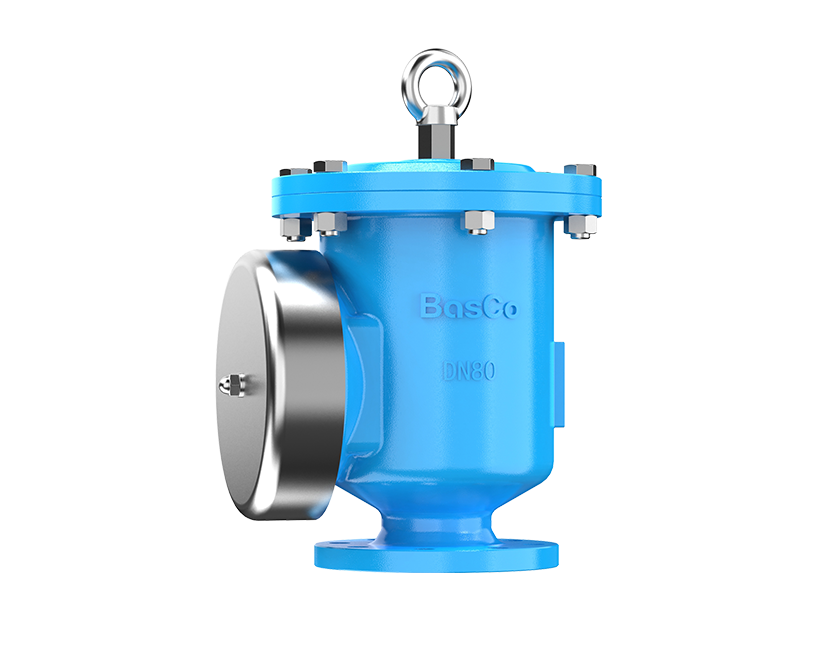
BASCO End-of-line Pressure Vacuum Relief Valve with Integrated Flame Arrester
Once a flame arrester or additional piping is introduced, pressure drop becomes a critical factor.
If the total system resistance exceeds acceptable limits, the valve may no longer provide sufficient venting capacity. In such cases, the system must be re-evaluated.
This may involve increasing valve size, reducing resistance, or redesigning the configuration. Skipping this step is one of the most common causes of underperforming systems.
Instead of thinking of this as a checklist, I treat it as a complete engineering input package.
|
Parameter |
Example |
|
Tank volume |
500 m³ |
|
Liquid type |
Methanol |
|
Temperature range |
-10 ~ 45°C |
|
Design pressure |
+17.5 mbar |
|
Vacuum rating |
-5 mbar |
|
Venting requirement |
API 2000 calculated |
A well-prepared input set reduces back-and-forth and leads to more accurate vendor proposals.
Across multiple projects, the same patterns repeat. The most common issue is not lack of knowledge, but incomplete application of it. For example, API 2000 may be referenced but not fully applied, or a valve may be selected correctly but installed with additional resistance that was never accounted for.
What stands out is that most failures are not dramatic design errors—they are small oversights that compound over time.
When I review RFQs, the difference between a smooth project and a delayed one usually comes down to input clarity.
A complete RFQ should clearly define tank parameters, operating conditions, and any compliance requirements. When this information is structured properly, suppliers can respond quickly and accurately. When it's incomplete, the process turns into multiple revision cycles.
From my perspective, breather valve selection is not about picking a product—it's about understanding how a tank behaves under real operating conditions. The most reliable systems are the ones where calculation, pressure setting, and valve design are treated as a connected decision, not separate steps.
If you're working on a project right now, I strongly recommend walking through the same logic step by step. It may seem more detailed upfront, but it will significantly reduce risk, rework, and long-term operational issues.
It's a standard that defines how to calculate required venting capacity for storage tanks under pressure and vacuum conditions.
They are essentially the same.“Breather valve” is a general term, while PVRV is the technical name.
Yes, but you must account for additional pressure drop and recalculate venting capacity.

Where Are Rupture Disks Used in Chemical and Petrochemical Plants?
2026-09-21Burst Pressure Tolerance Explained: How Accurate Are Rupture Disks?
2026-09-16Full-Process Quality Control for Rupture Discs
2026-09-01Rupture Disk Selection Guide: How to Choose the Right Type, Pressure, Material, and Size
2026-08-25Copyright © Jiangsu Bafang Safety Device Co., LTD. All Rights Reserved