












In atmospheric storage tank systems, one of the most overlooked engineering risks is improper venting. I’ve seen tanks damaged not because of catastrophic overpressure events, but because normal thermal breathing and transfer operations were not properly managed. In many facilities, operators focus heavily on process equipment while underestimating the importance of the venting system sitting on top of the tank.
From my experience as a BASCO engineer working on tank protection systems, an end-of-line pressure vacuum relief valve (PVRV) is one of the most critical components in atmospheric tank venting. Its role is not simply to release pressure—it is to maintain safe internal tank pressure during both positive and negative pressure conditions while venting directly to atmosphere at the terminal end of the vent line. What makes end-of-line configurations different is the combination of venting behavior, environmental exposure, flame protection requirements, and API 2000 sizing considerations. Choosing the wrong configuration can result in excessive emissions, unstable venting, premature valve wear, or even tank deformation.
In this article, I’ll explain how end-of-line PVRVs work, why installation location matters, how they integrate with flame arresters, and how we approach sizing and selection in real industrial projects.
What Is an End-of-Line Pressure Vacuum Relief Valve?
An end-of-line pressure vacuum relief valve is a venting device installed at the terminal point of a tank vent system where discharge occurs directly to atmosphere.
From an engineering standpoint, the phrase “end-of-line” is extremely important because it defines the installation condition. Unlike inline venting arrangements located within piping systems, an end-of-line PVRV is positioned at the atmospheric discharge point, meaning it is directly exposed to environmental conditions such as rain, wind, temperature variation, and potential ignition sources.
In practical applications, these valves are commonly mounted on storage tank roofs or vent stacks to protect atmospheric and low-pressure tanks from excessive internal pressure or vacuum conditions.
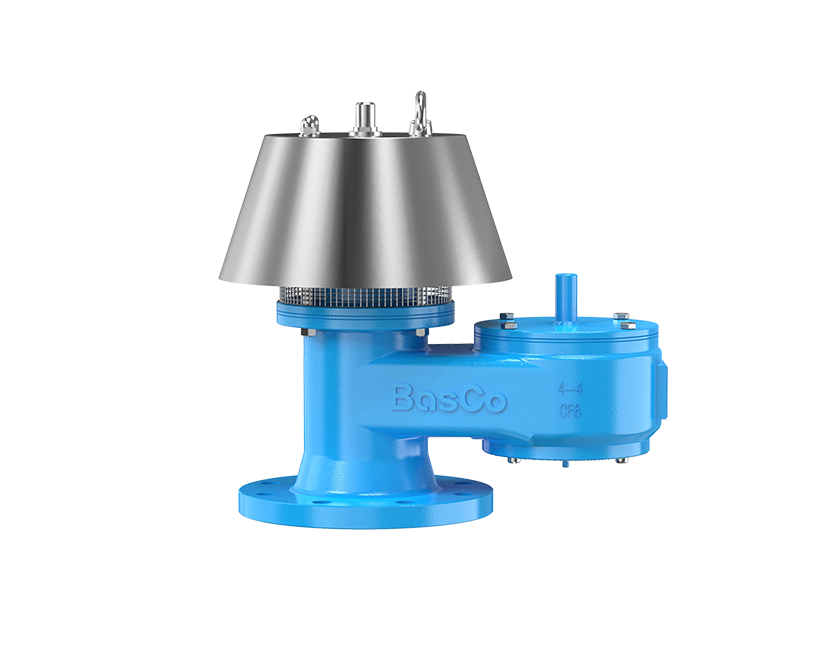
BasCo End-of-Line Pressure Vacuum Relief Valve
How Does an End-of-Line PVRV Work?
An end-of-line PVRV protects the tank by balancing internal pressure during normal operating conditions. The valve remains closed during stable operation to minimize vapor loss and environmental emissions. Once pressure or vacuum exceeds the set point, the valve opens automatically to relieve the condition.
How Does Pressure Relief Work in an End-of-Line PVRV?
During pressure buildup, the pallet inside the valve lifts once the internal tank pressure exceeds the set pressure.
This allows vapors to discharge safely to atmosphere and prevents excessive stress on the tank shell or roof. From my experience, pressure events are most commonly caused by thermal expansion or liquid filling operations.
How Does Vacuum Relief Work in an End-of-Line PVRV?
Vacuum conditions occur when internal tank pressure drops below atmospheric pressure. When this happens, the vacuum pallet opens and allows atmospheric air to enter the tank. This prevents tank collapse caused by excessive inward pressure differential.
In real-world operations, vacuum conditions are especially common during pump-out operations or sudden cooling events.
Why Do Storage Tanks Need End-of-Line Venting?
Storage tanks continuously experience pressure fluctuations even under normal operation. In many systems, these changes are relatively small, but over time they create significant stress if venting is not properly managed.
How Does Thermal Breathing Affect Tank Pressure?
Thermal breathing occurs when ambient temperature changes cause vapor expansion and contraction inside the tank. During daytime heating, vapor expands and internal pressure increases. During nighttime cooling, pressure decreases and vacuum conditions can develop.
This breathing cycle occurs continuously in atmospheric tanks.
Why Do Pump-In and Pump-Out Operations Require Venting?
Whenever liquid enters or leaves the tank, vapor volume changes simultaneously. Filling operations displace vapor and increase pressure, while emptying operations create vacuum conditions.
From my experience, transfer operations are often the dominant venting scenario used for PVRV sizing under API 2000.

from valve-world.net
What Is the Difference Between an End-of-Line PVRV and a Standard PVRV?
This is one of the most misunderstood areas in tank venting design. A standard PVRV may be installed within a venting system where downstream piping exists. An end-of-line PVRV, however, vents directly to atmosphere and therefore operates under different environmental and flow conditions.
This distinction affects weather protection requirements, flame exposure risk, pressure drop behavior, and maintenance accessibility. From an engineering perspective, the installation location fundamentally changes the valve operating environment.
| Feature | End-of-Line PVRV | Standard PVRV |
| Installation | Atmospheric discharge point | Inline vent system |
| Environmental exposure | Direct | Limited |
| Weather hood requirement | Common | Less critical |
| Flame exposure | Higher | Lower |
| Maintenance access | Usually external | Depends on layout |
How Are End-of-Line PVRVs Integrated with Flame Arresters?
In many storage tank systems, the PVRV is combined with an end-of-line flame arrester. This configuration provides both pressure protection and flame propagation prevention.
From my experience at BASCO, this integrated approach is common in systems handling flammable vapors where ignition sources may exist near the vent outlet. The flame arrester protects against flashback from external ignition, while the PVRV manages normal breathing conditions.
One important engineering consideration is pressure drop. Adding a flame arrester changes flow resistance, which must be considered during sizing calculations.
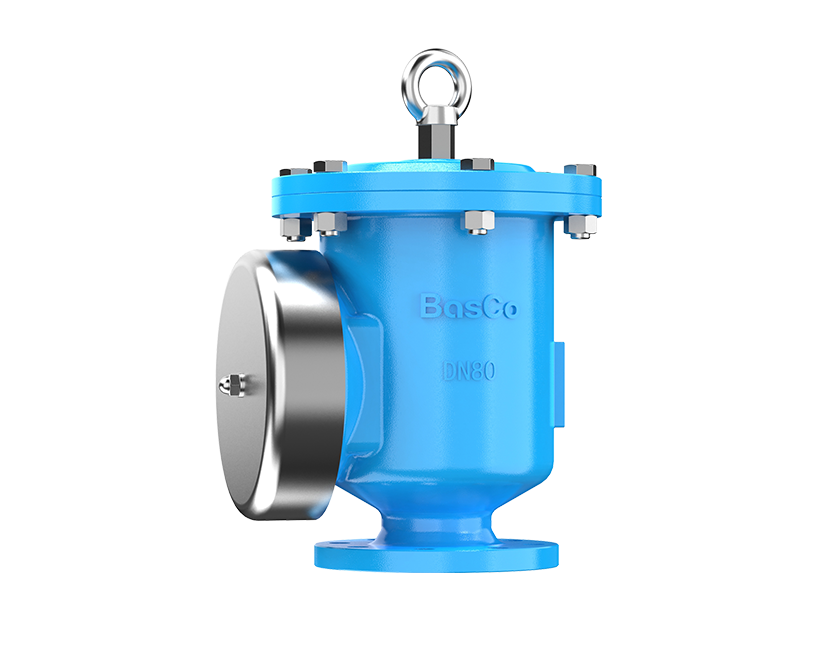
BasCo End-of-line Pressure Vacuum Relief Valve with Integrated Flame Arrester
How Does API 2000 Affect End-of-Line PVRV Sizing?
API 2000 is one of the most important standards governing atmospheric tank venting. The standard defines venting requirements for both normal and emergency conditions.
What Does API 2000 Consider in Venting Calculations?
API 2000 sizing considers several operating scenarios, including thermal breathing and liquid transfer rates. In emergency venting cases, fire exposure may also be considered.
From an engineering perspective, the critical task is identifying which operating condition governs the required venting capacity.
Why Is Pressure Drop Important in API 2000 Sizing?
Pressure losses through vent piping, flame arresters, and valve internals directly affect valve performance. In end-of-line configurations, excessive pressure drop can reduce effective venting capacity and alter opening characteristics.
This is one of the reasons why venting systems must be evaluated as a complete assembly rather than as isolated components.
What Factors Should Be Considered When Selecting an End-of-Line PVRV?
Selection should always begin with understanding the tank operating conditions.
How Does Set Pressure Affect Selection?
Set pressure determines when the valve begins to open. The selected pressure must remain within the allowable pressure limits of the storage tank while minimizing unnecessary venting losses.
Why Is Flow Capacity Critical?
The valve must handle both pressure and vacuum flow requirements during worst-case operating conditions. Insufficient capacity can lead to tank deformation or excessive emissions.
How Does Material Selection Affect Reliability?
Material compatibility is critical in corrosive or outdoor environments. In coastal or chemical facilities, stainless steel construction is often preferred due to improved corrosion resistance.
Why Does the Environment Matter?
Because end-of-line PVRVs are directly exposed to atmosphere, environmental conditions significantly affect long-term reliability. Rain, dust, ice formation, and wind exposure can all influence valve performance.
| Parameter | Engineering Impact |
| Set pressure | Determines opening point |
| Flow capacity | Defines venting performance |
| Material | Affects corrosion resistance |
| Environment | Impacts long-term reliability |
| Flame protection | Determines safety integration |
What Are the Most Common Mistakes in End-of-Line Venting Design?
One of the most common mistakes is treating the PVRV as an isolated device rather than part of a complete venting system.
I’ve also seen systems where flame arresters were added without recalculating pressure drop, which reduced effective venting performance. Another frequent issue is underestimating environmental exposure. Outdoor installations require weather protection and proper drainage considerations.
Maintenance accessibility is also often overlooked. In real facilities, difficult access can lead to poor inspection frequency and reduced long-term reliability.
Conclusion
End-of-line pressure vacuum relief valves are a critical part of atmospheric storage tank protection systems. Their role extends beyond simple venting to include pressure management, vapor control, environmental exposure handling, and flame protection integration.
From my experience at BASCO, successful venting system design depends on understanding the complete interaction between tank breathing behavior, API 2000 sizing requirements, installation conditions, and integrated flame protection.
For engineers and tank operators, selecting the correct end-of-line PVRV is not just about choosing a valve—it is about designing a reliable and safe tank venting system for long-term operation.