

In many storage tank and process vent systems, the risk of ignition does not originate inside the equipment but from the atmosphere surrounding the vent outlet. I often see projects where engineers initially focus on pressure control devices like PVRVs or conservation vents but underestimate the possibility that an external ignition source could send a flame back through the vent line. When flammable vapors are present, this scenario can allow combustion to travel toward the tank or process vessel.
From an engineering standpoint, an end-of-line flame arrester is specifically designed to stop atmospheric deflagration from entering a vent line or tank vapor space. When installed correctly at the open end of a pipe, it prevents external flames from propagating into the system. However, its effectiveness depends on several key factors including the gas explosion group, vent flow rate, installation geometry, and whether flame acceleration inside the pipeline is possible. In cases where flame propagation may occur within the pipe itself, an in-line flame arrester is usually required instead.
To clarify how engineers should approach this decision, I will walk through the definition of end-of-line flame arresters, explain their working principle, compare them with in-line designs, and outline the practical selection criteria used in real tank and process installations.
An end-of-line flame arrester is a safety device installed at the open end of a vent pipe or discharge line to prevent flame propagation back into a protected system. According to EN ISO 16852 terminology, the device is intended for installation at the atmospheric outlet of a vent line rather than somewhere within the pipeline network.
The term “end-of-line” refers directly to its installation position. Instead of being mounted in the middle of a pipe run, the device sits at the pipe termination where vapors are released to the surrounding atmosphere. In this location it forms a barrier that stops flames originating outside the system from entering the vent line.
In many industrial facilities, these devices are used in combination with storage tank breathing systems. When tanks release vapors during thermal expansion or product transfer, the flame arrester ensures that ignition sources outside the tank cannot allow combustion to travel back into the vapor space.

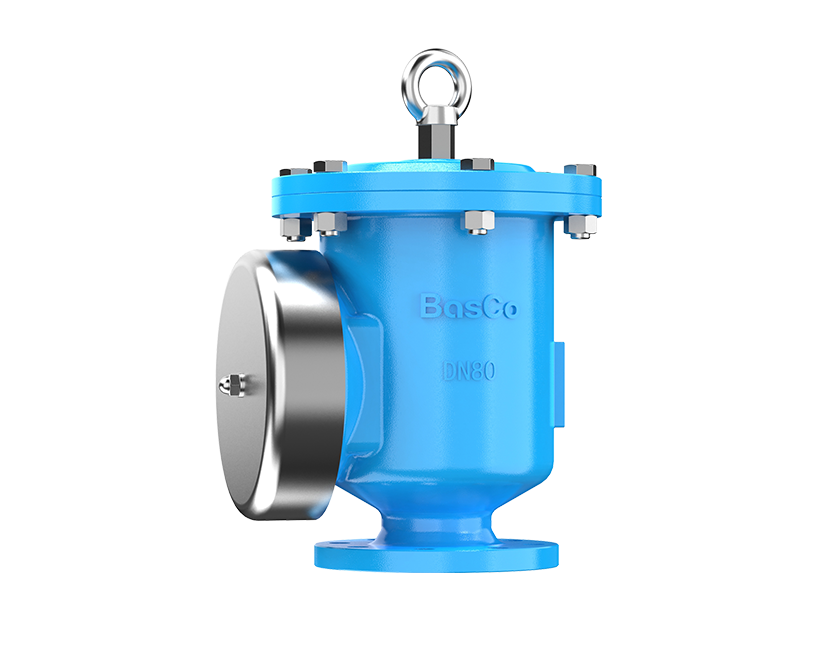
BASCO End of Line Flame Arrester
The operating principle of a flame arrester relies on flame quenching. Inside the housing, a flame arresting element creates a network of narrow passages formed by stacked metal ribbons, crimped strips, or similar structures. When a flame front attempts to pass through these channels, heat is rapidly absorbed by the metal surfaces.
As the flame temperature drops below the ignition temperature of the gas mixture, combustion cannot continue and the flame is extinguished before it reaches the protected side of the device.
End-of-line flame arresters are primarily designed for atmospheric deflagration scenarios. In this situation, ignition occurs outside the process system, perhaps from static electricity, open flames, or nearby equipment.
Because the arrester sits directly at the vent outlet, it blocks the flame before it can travel through the vent piping toward the tank or vessel.
The installation location strongly influences flame behavior. When the arrester is located directly at the pipe outlet, flame travel distance inside the pipe is limited. However, if long vent lines exist upstream of the device, flame acceleration within the pipeline can occur.
This is why engineers must evaluate vent line geometry carefully during system design.
Although both devices rely on similar flame-quenching principles, their intended applications are different.
End-of-line arresters protect against ignition sources outside the system, while in-line arresters are designed to stop flames traveling through a pipeline.
|
Engineering Factor |
End-of-Line Flame Arrester |
In-Line Flame Arrester |
|
Installation position |
At vent outlet |
Installed inside pipeline |
|
Main ignition source |
External atmospheric ignition |
Internal pipeline ignition |
|
Flame propagation distance |
Short |
Potentially long |
|
Flame acceleration risk |
Low |
Higher |
|
Typical applications |
Tank vents, storage vessels |
Process piping, vapor recovery |
In practice, this distinction becomes important when vent lines are long or include multiple bends. In those cases, flame propagation within the pipe may require an in-line flame arrester.
One of the most common uses is on atmospheric storage tanks. During breathing cycles, vapors are released through conservation vents or free vents. An end-of-line flame arrester protects the tank vapor space from external ignition.
Fuel storage tanks, solvent tanks, and chemical storage vessels frequently use these devices when flammable vapors are present near vent outlets.
Some process vessels release vapors through dedicated vent piping. Installing a flame arrester at the outlet prevents flames from entering the system through those vents.
Selecting the correct flame arrester requires evaluating several engineering parameters rather than simply matching pipe diameter.
The explosion group of the gas mixture determines flame propagation characteristics. Gases with smaller MESG values require more restrictive flame arrester elements.
|
Explosion Group |
Example Gases |
Relative Flame Severity |
|
IIA |
Propane, gasoline vapors |
Lower |
|
IIB |
Ethylene |
Medium |
|
IIC |
Hydrogen, acetylene |
Highest |
Equipment certified for one explosion group cannot automatically be used for another.
Vent systems must maintain adequate flow capacity during tank breathing or pressure relief. Flame arresters introduce resistance, so the allowable pressure drop must be evaluated during design.
Material selection depends on both the process conditions and environmental exposure. Stainless steel elements are often preferred where corrosion or contamination is possible.
Matching plant piping standards simplifies installation. Flanged connections are most common for tank vent systems.
Outdoor installations require additional attention to environmental exposure. Rain, dust accumulation, and debris can affect the performance of the flame arresting element.
Certification is an essential part of flame arrester specification.
This international standard defines testing requirements and performance classifications for flame arresters.
ATEX certification confirms suitability for use in explosive atmospheres under European regulations.
Depending on the region or industry, additional approvals may be required by project specifications or regulatory authorities.
In many projects, flame arrester specification errors occur because the device appears relatively simple.
One common mistake is selecting equipment solely based on pipe size. While diameter determines mechanical compatibility, it does not ensure that the arrester can handle the required gas group or flame scenario.
Another issue is overlooking the burning scenario. Some applications may involve sustained burning at the arrester surface rather than a short-duration flame event.
Maintenance access is also sometimes neglected. If the device cannot be inspected or cleaned easily, operational reliability may decline over time.
Flame arresters require periodic inspection to ensure reliable operation.
Contamination is one of the most common operational concerns. Dust accumulation, corrosion products, or crystallized vapors can block the arrester element and increase pressure drop.
Designs with removable elements or modular construction simplify inspection and cleaning, which can significantly reduce lifecycle costs.
|
Maintenance Factor |
Operational Impact |
|
Fouling or clogging |
Reduced vent capacity |
|
Corrosion |
Structural degradation |
|
Limited inspection access |
Increased maintenance difficulty |
|
Replaceable elements |
Lower lifecycle cost |
Planning maintenance access during the design stage often improves long-term system reliability.
When requesting quotations from flame arrester manufacturers, providing complete technical information helps ensure accurate recommendations.
Typical RFQ information includes gas composition, explosion group, vent flow rate, operating pressure, temperature range, and connection size. Installation orientation and environmental conditions may also influence the design.
Providing these parameters early in the procurement process reduces the need for repeated clarification and helps suppliers confirm certification compatibility.
From an engineering perspective, end-of-line flame arresters play a critical role in protecting tank vent systems and process equipment from external ignition sources. Although the device itself appears relatively straightforward, selecting the correct model requires careful evaluation of gas properties, vent system geometry, operating conditions, and certification requirements.
When these factors are properly considered, an end-of-line flame arrester can provide reliable protection against atmospheric flame propagation and contribute significantly to overall plant safety.
For storage tanks, process vessels, and other vented systems handling flammable vapors, taking the time to review these parameters before requesting quotations can prevent specification errors and improve long-term operational performance.
It is a flame arrester installed at the outlet of a vent line to prevent external flames from propagating into a tank or process system.
Most industrial projects require EN ISO 16852 certification and may also require ATEX approval depending on regional regulations.
Inspection frequency depends on operating conditions. Systems exposed to fouling or corrosion may require more frequent inspection than clean vapor systems.

How to Size a Pressure Vacuum Relief Valve According to API 2000
2026-08-18Flame Arrester Guide: Types, Applications, Selection, and Industrial Solutions
2026-08-04Common Causes of Dust Collector Explosions and How to Protect Against Them
2026-07-13BasCo conducts "CPR+AED Emergency Training to Strengthen Workplace Life Safety Defense"
2026-06-18Copyright © Jiangsu Bafang Safety Device Co., LTD. All Rights Reserved