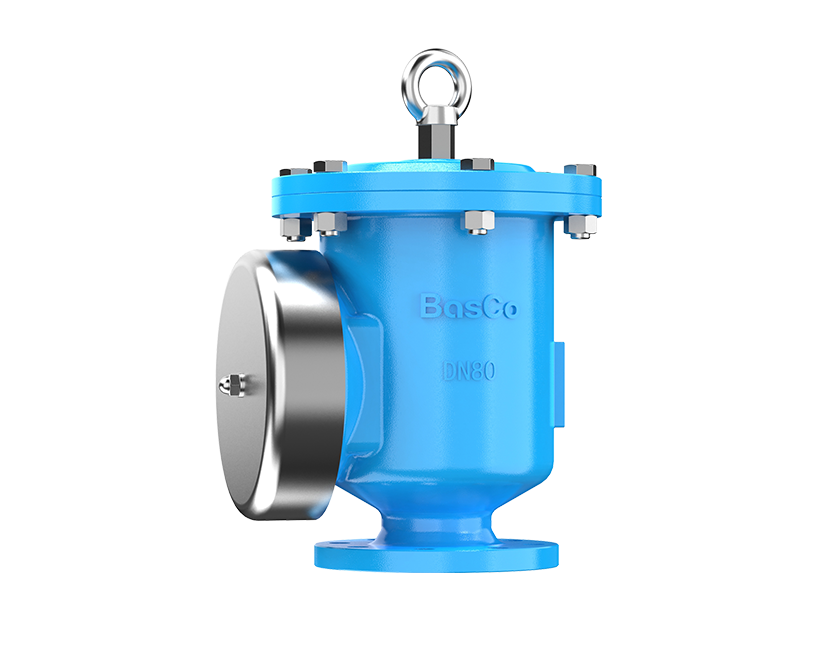
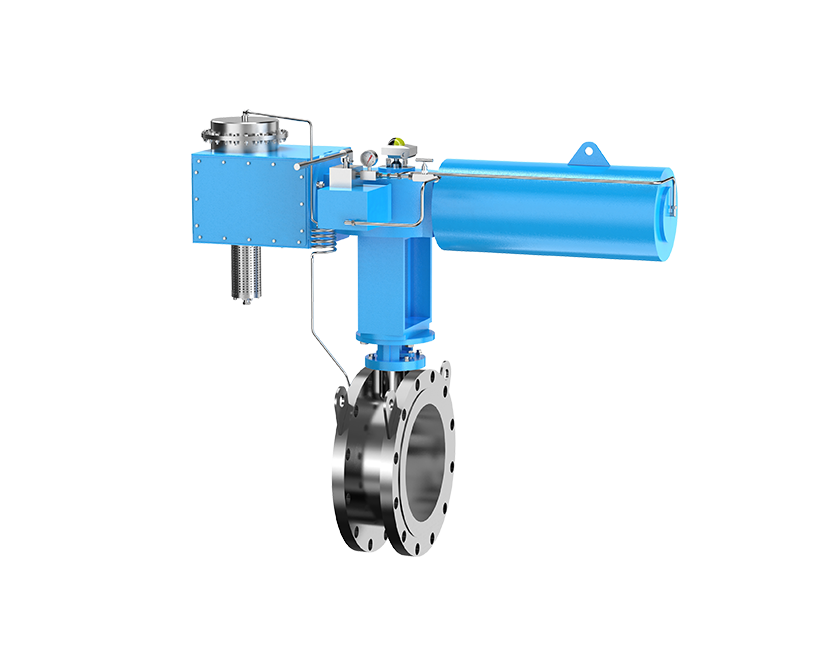
What Is a Buckling Pin Relief Valve?
A buckling pin relief valve—often shortened to buckling pin device or BPRV—is a mechanical safety valve designed to protect pressurized equipment from overpressure or vacuum conditions. Instead of using a spring like a conventional relief valve or a burst membrane like a rupture disc, a buckling pin valve relies on a precision-calibrated metal pin that buckles at an exact load and triggers the valve to open.
Engineers often describe this pin as a “mechanical fuse”. Once the system reaches its predetermined set pressure, the compressive force on the pin reaches a critical buckling point. The pin snaps or collapses instantly, releasing a latch that opens the valve to full bore. The result is rapid, predictable, and high-capacity pressure relief.
This mechanism places BPRVs in a unique category: not fully like a rupture disc, not fully like a spring-loaded safety valve, but a hybrid solution that offers accuracy, speed, and field resetability—all without exposing the critical pin element to aggressive process media.
BPRVs are widely used across gas, liquid, steam, slurry, and cryogenic applications, and they are especially valued in systems where high flow capacity and minimal downtime are top priorities.
How a Buckling Pin Relief Valve Works
Although designs vary between manufacturers, the working principle remains consistent:
1. The Role of the Calibrated Pin
At the heart of a BPRV is a metal pin engineered to buckle at a precise compressive load. The buckling behavior follows classical mechanical principles—most commonly Euler's law—balancing the pin's:
▪ Diameter
▪ Length
▪ Material stiffness
▪ Column geometry
Because these variables can be tightly controlled, the buckling pressure can be extremely accurate and repeatable.
2. Pressure Rises Toward the Set Point
As system pressure builds—whether in a pressure vessel, pipeline, LNG trailer, or slurry system—the compressive load acts on the pin. The valve remains closed and sealed until the force reaches its engineered buckling threshold.
Instantaneous Buckling and Full Opening
Once the pressure reaches the set point, the pin abruptly buckles, releasing a latch or trigger mechanism. This allows the valve disc to swing open immediately and completely, providing full-bore flow, similar to the instantaneous response of a rupture disc.
3. Non-Reclosing Action
Like rupture discs, buckling pin devices are non-reclosing. After activation, the valve stays open until the operator manually resets it. Resetting usually requires nothing more than:
▪ Replacing the buckled pin
▪ Re-engaging the latch or closing mechanism
This avoids the teardown or flange disassembly often required when replacing rupture discs.

Why Industries Choose Buckling Pin Relief Valves
In many industrial applications, safety relief devices must balance accuracy, fast response, corrosion resistance, flow capacity, and lifecycle cost. BPRVs excel in environments where predictability and rapid opening are top priorities.
Because buckling pin relief valves are often used on storage tanks, they fit naturally into a broader safety architecture. For readers seeking a full engineering-level overview of tank venting, breathing behavior, and coordinated protection devices, our Complete Tank Protection System Guide provides a comprehensive foundation.
1. Precision Close to Set Pressure
Most BPRVs support operating pressures up to 95% of the set pressure, significantly higher than many rupture discs. That higher allowable operating ratio is valuable in:
▪ Chemical reactors
▪ Gas compression lines
▪ Cryogenic and LNG systems
▪ Heat exchangers
▪ Slurry and slurry transport pipelines
Running closer to the set pressure helps operators maximize throughput without sacrificing safety.
2. Rapid, Full-Bore Pressure Relief
Because the buckling pin fails instantly and mechanically, the relief event is fast and clean. This is especially advantageous for:
▪ Rapid surge mitigation
▪ High-flow gas and vapor relief
▪ Liquid-phase overpressure events
▪ Conditions with unpredictable pressure spikes
Where a spring-operated valve might modulate or“chatte”, a BPRV opens decisively.
3. External Pin Position for Improved Reliability
A major benefit—often overlooked—is that the pin is located outside the process fluid path. That isolation means:
▪ Media corrosion does not affect the pin
▪ Deposits, particulates, or fouling cannot jam the mechanism
▪ Maintenance is easier and more predictable
In corrosive or abrasive environments, these advantages can dramatically reduce lifecycle cost.
4. Resettable Without Removing the Valve
Unlike rupture discs, which require full replacement and sometimes spool removal, a BPRV can often be reset on-site, without touching the pipeline flanges. For facilities operating continuously—LNG trailers, petrochemical reactors, storage tanks—this translates into meaningful reductions in downtime.

Industrial Applications for Buckling Pin Relief Valves
Buckling pin technology has become a go-to solution in systems where safety, reliability, and high relief capacity converge. Examples include:
1. Pressure Protection in Vessels and Tanks
Reactors, separators, storage tanks, and heat exchangers all rely on overpressure protection. In these cases, BPRVs provide dependable relief with minimal maintenance—particularly when the process media is corrosive or erosive.
2. High-Pressure and High-Temperature Pipeline Protection
Large-diameter pipelines, steam lines, and slurry lines benefit from the valve's simple, robust mechanics. Heavy-duty angle-body BPRVs are frequently selected for rugged environments where springs or membranes would degrade.
3. LNG and Cryogenic Systems
Compact buckling pin devices are used extensively on LNG trailers and transfer systems due to:
▪ High accuracy
▪ Rapid relief performance
▪ Compatibility with cryogenic temperatures
▪ Ease of field reset
In mobile or transport applications, reliability and downtime reduction are critical.
4. Vacuum Relief for Specialized Systems
Some designs can operate in reverse, offering vacuum protection for delicate vessels or thin-walled tanks. This gives operators a multipurpose solution from the same mechanical principle.
Advantages of Buckling Pin Relief Valves
1. Predictable Set Pressure
Because the buckling mechanism is purely mechanical, it eliminates challenges associated with spring relaxation, temperature effects, and long-term drift.

2. Resistance to Cyclic Fatigue
Pins operate in compression, not tension, making them more resistant to fatigue caused by pulsating pressure conditions.
3. Large Size Availability
Manufacturers offer buckling pin valves from small 1-inch units to very large diameters exceeding one meter. This flexibility supports both compact skid-mounted equipment and large industrial lines.
4. Suitability for Harsh Media
Since the pin is isolated from the fluid path, corrosive service—and even abrasive slurry—doesn't compromise actuation reliability.
5. Lower Maintenance Burden
Installation does not require precision torqueing or breakaway membranes, and resetting is fast. For operators experiencing occasional overpressure events, BPRVs offer an excellent balance of cost and performance.
Engineering Considerations and Design Constraints
Despite their versatility, buckling pin systems must be engineered carefully. The design constraints stem mainly from the mechanics of the buckling pin itself.
1. High-Pressure or Very Large-Diameter Valves
At extreme pressures or very large bore sizes, designing a pin with an appropriate buckling load may require:
▪ Composite or alloy materials
▪ Reinforced pin columns
▪ Multi-pin configurations
▪ Pilot-assisted mechanisms
This doesn't limit the applicability of BPRVs but does require engineering experience during specification.

2. Single-Use Activation
Once the pin buckles, it must be replaced. Facilities with frequent relief events may prefer a reclosing spring valve, while those with rare but critical relief events often choose a BPRV for reliability.
Comparison Table: Buckling Pin Relief Valves vs. Rupture Discs vs. Spring-Loaded Valves
Feature / Capability | Buckling Pin Relief Valve | Rupture Disc | Spring-Loaded Relief Valve |
Opening Behavior | Instant, full-bore | Instant, full-bore | Gradual / modulating |
Reset After Activation | Replace pin (simple) | Replace disc (more involved) | Automatic reclosing |
Accuracy / Predictability | Very high | High | Moderate, may drift |
Exposure to Process Media | Pin isolated | Disc exposed | Spring exposed to media (in most designs) |
Suitable for Corrosive Service | Excellent | Good, depends on disc material | Requires material compatibility |
Operating Ratio (Typical) | Up to ~95% of set pressure | ~70–90% | ~90–95% |
Best Uses | High-flow, minimal downtime applications | One-time, fail-safe, low-cost relief | Frequent cycling, modulating relief needs |
Real-World Relevance: How Industry Uses Buckling Pin Valves
Across the materials uploaded, the documented examples illustrate how manufacturers deploy different buckling pin valve models—such as angle-type valves for pipeline protection, compact models for LNG relief, and high-pressure designs for slurry systems. These examples highlight a recurring theme in industry: mechanical simplicity paired with precise performance.
Many engineering teams prefer BPRVs because the technology removes uncertainty associated with springs, corrosion, and thermal degradation. And because the pin is easy to inspect and replace, operators get a clear and straightforward maintenance path—a major advantage in industries where uptime is critical.

Conclusion: Why Buckling Pin Relief Valves Matter in Modern Industry
Buckling pin relief valves offer a rare combination of accuracy, high flow capacity, fast actuation, corrosion resistance, and easy resetability. As industrial processes grow more complex—and as operators push systems closer to design limits—the need for predictable, reliable, and field-serviceable safety devices becomes even more significant.
For facilities handling gases, liquids, slurries, cryogenic fluids, or corrosive media, BPRVs provide a strong alternative to both rupture discs and spring-loaded valves. They deliver peace of mind, operational efficiency, and a long service life with minimal maintenance.
Finally
If you're evaluating overpressure protection options for new equipment or considering an upgrade from traditional safety relief technologies, a buckling pin relief valve deserves a close look. And if you need technical guidance—sizing, materials, set pressure calculations, or application matching—BASCO is here to help you evaluate the best fit for your system.